

What is an acoustic neuroma?
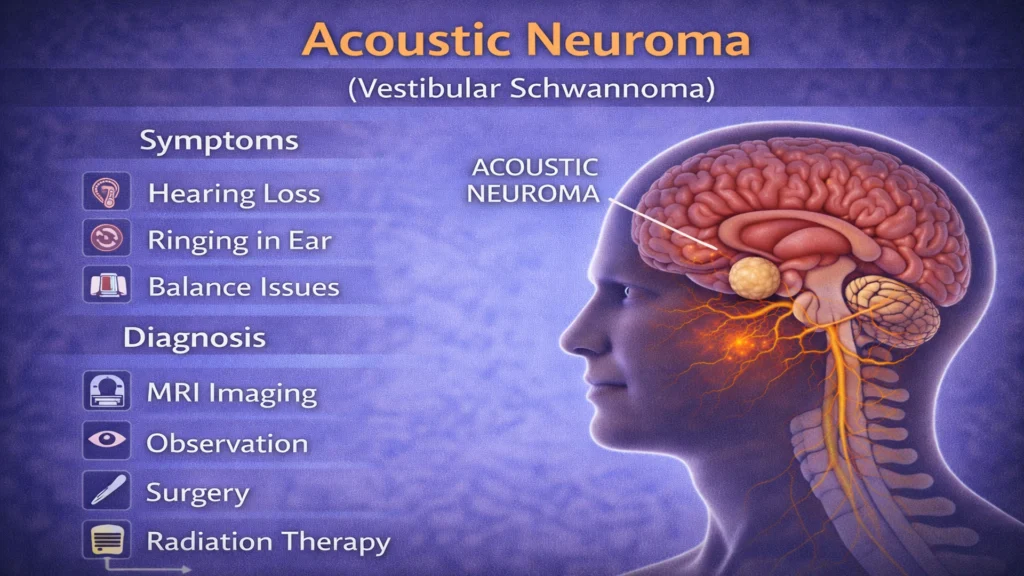
An acoustic neuroma, also known as a vestibular schwannoma, is a benign tumor that develops from Schwann cells covering the vestibular nerve, which plays a key role in hearing and balance. The tumor typically grows slowly and is not cancerous, but it can still cause significant symptoms due to its location near critical brain structures.
Acoustic neuromas usually affect one side, though bilateral tumors may occur in rare genetic conditions. Early detection allows for a wider range of management options.
How vestibular schwannoma develops
Vestibular schwannomas arise when Schwann cells begin to grow abnormally along the vestibular portion of the eighth cranial nerve. As the tumor enlarges, it may compress nearby nerves and brain structures, leading to progressive symptoms.
The exact cause is usually unknown. Most cases are sporadic and not inherited. The tumor’s growth rate varies and may remain stable for long periods.
Common symptoms
Symptoms often develop gradually and may initially be subtle. The most common early signs include hearing loss on one side, tinnitus (ringing in the ear), and balance disturbances.
As the tumor grows, additional symptoms may include dizziness, facial numbness or weakness, headaches, and difficulty with coordination. Larger tumors can affect adjacent cranial nerves and brainstem structures.
Diagnosis
Diagnosis typically involves a detailed neurological and otological evaluation. MRI of the brain and internal auditory canals is the primary imaging method used to confirm the presence, size, and extent of the tumor.
Audiological testing helps assess hearing function and supports treatment planning.
Management and treatment options
Treatment is individualized and depends on tumor size, growth rate, symptoms, age, and overall health.
Observation (active surveillance)
For small, slow-growing tumors with minimal symptoms, regular monitoring with imaging and hearing tests may be appropriate.
Surgical treatment
Surgery may be recommended for growing tumors or when neurological symptoms progress. The goal is tumor removal while preserving nerve function whenever possible.
Radiation-based treatment
In selected cases, targeted radiation may be used to control tumor growth.
Supportive and symptomatic care remains important throughout all stages of management.
Prognosis
Because vestibular schwannomas are benign, long-term survival is generally excellent. Outcomes depend on tumor size at diagnosis, growth behavior, and treatment approach.
Many patients maintain good neurological function, especially when tumors are detected early and carefully monitored or treated.
When to seek medical evaluation urgently
Prompt evaluation is advised if there is sudden hearing loss, rapid worsening of balance, facial weakness, numbness, or persistent headaches. These symptoms may indicate tumor growth or nerve involvement requiring timely assessment.
FAQ — Acoustic Neuroma
It is a benign tumor arising from the vestibular portion of the hearing and balance nerve.
No. It is a benign tumor, but it can still cause serious symptoms due to pressure on nearby structures.
No. Some tumors can be safely monitored without immediate intervention.
In many cases, hearing preservation is possible, especially with early diagnosis and careful management.
Yes. These terms refer to the same condition.
Usually it affects one ear. Bilateral tumors are rare and may be associated with genetic conditions.


